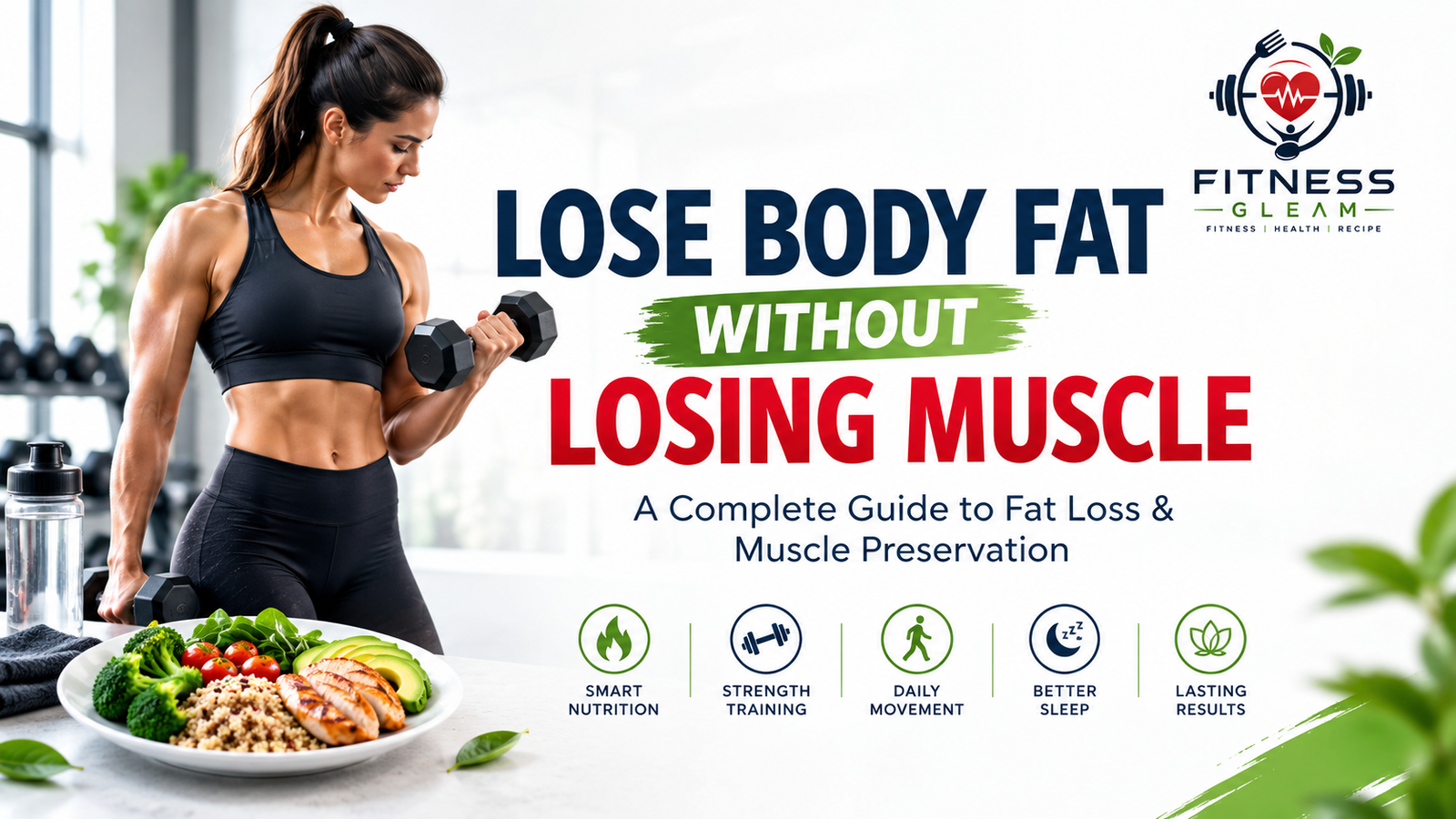
How to Lose Body Fat Without Losing Muscle: A Complete Guide
Losing body fat sounds simple: eat fewer calories, exercise more, and watch the number on the scale go down. But there is an important problem with approaching fat loss this way – not all weight loss comes from body fat.
If your calorie deficit is too aggressive, your protein intake is too low, or you stop strength training, you may lose valuable muscle along with fat. The goal should not simply be to become lighter. It should be to lose body fat while maintaining as much lean muscle as possible.
This approach is sometimes called body recomposition, and it combines sensible nutrition, resistance training, adequate protein, daily movement, and recovery.
Here’s how to do it.
What Does It Mean to Lose Body Fat Without Losing Muscle?
Your body weight is made up of several components, including muscle, fat, water, bones, organs, and other tissues.
When you lose weight, you want most of the reduction to come from stored body fat, while preserving your muscle mass.
That means the scale isn’t the only measurement that matters.
You should also pay attention to:
- Waist measurement
- Progress photos
- Strength in the gym
- How your clothes fit
- Body weight trends over several weeks
- Overall energy and recovery
A slower rate of weight loss can sometimes be better for preserving muscle than trying to lose weight as quickly as possible.
1. Create a Moderate Calorie Deficit
The foundation of fat loss is a calorie deficit: consistently consuming fewer calories than your body uses.
However, bigger isn’t always better.
A very aggressive deficit can make it harder to train effectively, recover properly, and maintain muscle. Instead, aim for a moderate, sustainable calorie deficit that allows you to lose fat while still having enough energy for daily life and exercise.
Your calorie needs depend on factors such as:
- Age
- Sex
- Height
- Body weight
- Activity level
- Exercise routine
- Weight-loss goal
FitnessGleam’s Calorie & Macro Calculator can help you estimate your daily calorie needs and set a more structured starting point.
The goal isn’t to eat as little as possible. The goal is to create a deficit you can maintain consistently.
2. Eat Enough Protein
Protein is one of the most important nutrients when you’re trying to lose body fat while preserving muscle.
During a calorie deficit, getting enough protein gives your body the amino acids it needs to support muscle maintenance and recovery.
A practical target for many active adults is around 1.6–2.2 grams of protein per kilogram of body weight per day, although individual needs can vary.
For example, someone weighing 70 kg might aim for roughly 112–154 grams of protein per day.
Instead of guessing, you can use the Protein Calculator to estimate your personal protein target.
Good protein sources include:
- Eggs
- Greek yogurt
- Chicken
- Fish
- Lean meat
- Cottage cheese
- Tofu
- Lentils
- Beans
- Milk
- Protein-rich smoothies
You can also spread protein across several meals instead of trying to consume most of it at dinner.
For convenient options during a busy workday, check FitnessGleam’s guide to high-protein, low-calorie snacks for office workers.
3. Keep Strength Training in Your Routine
If your goal is to keep muscle while losing fat, strength training should be one of your priorities.
Resistance training gives your body a reason to maintain muscle during a calorie deficit.
You don’t necessarily need to train every day. A consistent program using exercises such as:
- Squats
- Lunges
- Push-ups
- Rows
- Pull-ups
- Shoulder presses
- Deadlifts
- Hip thrusts
can provide a strong foundation.
The key is progressive overload – gradually improving your training over time through more repetitions, better technique, additional resistance, or increased training volume.
During fat loss, your strength may fluctuate because you’re eating fewer calories. Don’t panic if every workout isn’t a personal record. Focus on maintaining performance as much as reasonably possible.
4. Don’t Ignore Walking and Daily Movement
Cardio has its place in a fat-loss plan, but you don’t have to spend hours doing intense workouts.
Walking is an excellent way to increase daily energy expenditure without creating as much recovery demand as high-intensity exercise.
FitnessGleam’s guide on how many steps per day to lose weight explains practical ways to increase your daily movement gradually.
A simple approach is to track your current step count and slowly increase it.
For example:
| Daily habit | Practical target |
| Daily steps | 7,000–10,000+ |
| Strength training | 2–4 sessions/week |
| Protein | ~1.6–2.2 g/kg/day |
| Calorie deficit | Moderate and sustainable |
| Sleep | Around 7–9 hours |
| Recovery | At least 1–2 easier days/week |
These are starting points rather than rules that everyone must follow. Your ideal routine depends on your fitness level, lifestyle, goals, and health.
5. Don’t Eliminate Carbohydrates
Some people believe carbohydrates automatically prevent fat loss. They don’t.
You can lose body fat while eating carbohydrates.
Carbohydrates can actually be useful because they provide energy for training and everyday activity.
Choose mostly nutrient-dense sources such as:
- Oats
- Potatoes
- Rice
- Whole grains
- Fruit
- Beans
- Lentils
- Vegetables
The important factor for fat loss is your overall calorie intake—not whether a particular food contains carbohydrates.
6. Include Healthy Dietary Fats
Fat is also an important part of a balanced diet.
Foods such as nuts, seeds, olive oil, eggs, avocado, and fatty fish can provide essential fats and other nutrients.
The challenge is portion control. Fat contains more calories per gram than protein or carbohydrates, so foods like nuts and oils can add calories quickly.
You don’t need to remove them. Just include reasonable portions within your overall calorie target.
7. Use Cardio Strategically
You don’t need to turn every workout into a cardio session.
A combination of strength training and moderate cardio can work very well for fat loss.
Depending on your preferences, cardio could include:
- Brisk walking
- Cycling
- Swimming
- Jogging
- Hiking
- Elliptical training
Start with an amount you can recover from.
If adding more cardio makes you exhausted, weaker during strength workouts, constantly hungry, or unable to recover, it may be time to reduce the volume.
More exercise isn’t automatically better.
8. Prioritize Sleep and Recovery
Sleep is often overlooked when people focus on losing body fat.
Poor sleep can make it harder to maintain good eating habits, recover from workouts, and perform well during exercise.
Aim for a consistent sleep schedule and roughly 7–9 hours of sleep per night for most adults.
Your recovery routine should also include easier training days.
Muscle isn’t built during the workout itself. Training provides the stimulus; adequate nutrition and recovery allow your body to adapt.
If you’re interested in the connection between sleep and daily energy, FitnessGleam also covers why you can feel tired even after 8 hours of sleep.
9. Don’t Expect the Scale to Drop Every Day
Daily body weight can change because of:
- Water retention
- Sodium intake
- Carbohydrate intake
- Food volume
- Hormonal changes
- Muscle inflammation after training
That means a temporary increase on the scale doesn’t necessarily mean you’ve gained body fat.
Instead of judging your progress from one weigh-in, look at your weekly average and track the trend over several weeks.
You may also notice that your waist becomes smaller even when your weight changes slowly.
That’s why measurements, photos, and gym performance can be valuable alongside the scale.
10. Avoid These Common Fat-Loss Mistakes
Cutting calories too aggressively
Extreme dieting may produce rapid scale changes but can make it harder to maintain muscle and your diet long term.
Eating too little protein
A low-protein diet makes it harder to support muscle maintenance during a calorie deficit.
Doing only cardio
Cardio can help increase calorie expenditure, but strength training provides an important muscle-preservation stimulus.
Training hard without recovering
More workouts aren’t useful if your body never has time to recover.
Changing your plan every week
Fat loss takes time. Constantly switching diets, workouts, and calorie targets makes it difficult to know what is actually working.
Focusing only on body weight
Your goal is fat loss—not simply making the scale move downward.
Can You Lose Fat and Build Muscle at the Same Time?
Yes, it can happen, particularly in beginners, people returning to training after a break, and individuals with higher levels of body fat.
However, the rate at which you can build muscle while losing fat depends on training experience, nutrition, genetics, recovery, and starting body composition.
For experienced lifters who are already relatively lean and muscular, simultaneously gaining significant muscle and losing substantial fat becomes more difficult.
That’s why expectations matter.
For many people, a better initial goal is simply:
Lose fat gradually while maintaining strength and muscle.
What About Creatine During Fat Loss?
Creatine can be useful for people who strength train and are trying to maintain performance and muscle during a fat-loss phase.
Creatine monohydrate is one of the most researched sports supplements. FitnessGleam’s complete creatine guide covers dosage, timing, benefits, weight changes, and safety considerations.
One important point: creatine can increase body weight because of additional water stored in muscle. That isn’t the same thing as gaining body fat.
So don’t automatically assume that a small increase on the scale means your fat-loss plan has failed.
A Simple Fat-Loss Formula
If you want to make this process as simple as possible, focus on these fundamentals:
Moderate calorie deficit + sufficient protein + strength training + daily movement + adequate sleep + consistency
You don’t need a perfect diet.
You don’t need to eliminate entire food groups.
You don’t need to perform exhausting workouts every day.
And you don’t need to chase every new fat-loss trend.
Build a routine you can realistically follow for months.
Final Thoughts
Learning how to lose body fat without losing muscle is less about finding a secret diet and more about getting the fundamentals right.
Start with a moderate calorie deficit. Eat enough protein. Keep strength training. Walk regularly. Get adequate sleep and give your body enough time to recover.
Most importantly, judge progress over weeks and months—not from a single weigh-in.
If your waist measurement is gradually decreasing, your strength is relatively stable, and your overall fitness is improving, you’re likely moving in the right direction.
Fat loss doesn’t have to mean sacrificing the muscle you’ve worked hard to build. With a patient, structured approach, you can work toward a leaner body while maintaining strength and performance.
Note: This article is for general educational purposes and isn’t a substitute for individualized medical or nutrition advice. If you have a medical condition, take medication, are pregnant, or have a history of disordered eating, speak with a qualified healthcare professional before making significant changes to your diet or exercise routine.